Two of Africa's greatest wildlife areas, built on opposite ideas. Here is how the Delta and the Serengeti compare.
Plan a SafariThe Okavango Delta is a water-based wilderness in Botswana, explored by mokoro and 4x4, with the best wild dog viewing in Africa and small, exclusive fly-in camps. The Serengeti is vast savannah and the stage for the Great Migration. Choose the Delta for water and remoteness, the Serengeti for the migration and value.
They answer different questions. The Okavango Delta is about intimacy, water and exclusivity. The Serengeti is about scale, big cats and the largest land migration on earth. Neither is better; they are two different kinds of safari.
| Okavango Delta | Serengeti | |
|---|---|---|
| Landscape | Inland water delta | Open savannah plains |
| Signature | Wild dog, mokoro water safari | The Great Migration |
| Migration | No, resident game year-round | Yes, around two million animals |
| Cost per night | USD 1,000 to 3,000+ | Wider range, more affordable |
| Access | Fly-in small camps only | Fly-in or drive, many camps |
| Off-road & night drives | Yes, private concessions | Park no; conservancies yes |
| Water activities | Mokoro and boat | Limited |
| Big Five | Yes, rhino scarce | Yes, rhino very scarce |
| Feel | Remote, low volume | Vast, central areas busier |
| Best for | Water, exclusivity, wild dog | Migration, big cats, value |
The Okavango Delta is the defining difference. It is an inland delta where the Okavango River fans out across the Kalahari and never reaches the sea, creating a maze of channels, lagoons and islands. You explore it by mokoro, by boat and by 4x4. The Serengeti is the opposite: open grassland stretching to the horizon, the classic savannah of big skies and big cats.
The Serengeti holds the Great Migration, around two million wildebeest and zebra moving through the ecosystem year-round, with calving on the southern plains from late January to March and the Mara River crossings in the north from July to October. The Delta has no migration. Instead it has dense, resident game that concentrates as the floodwaters rise through the dry season, drawing predators to the water.
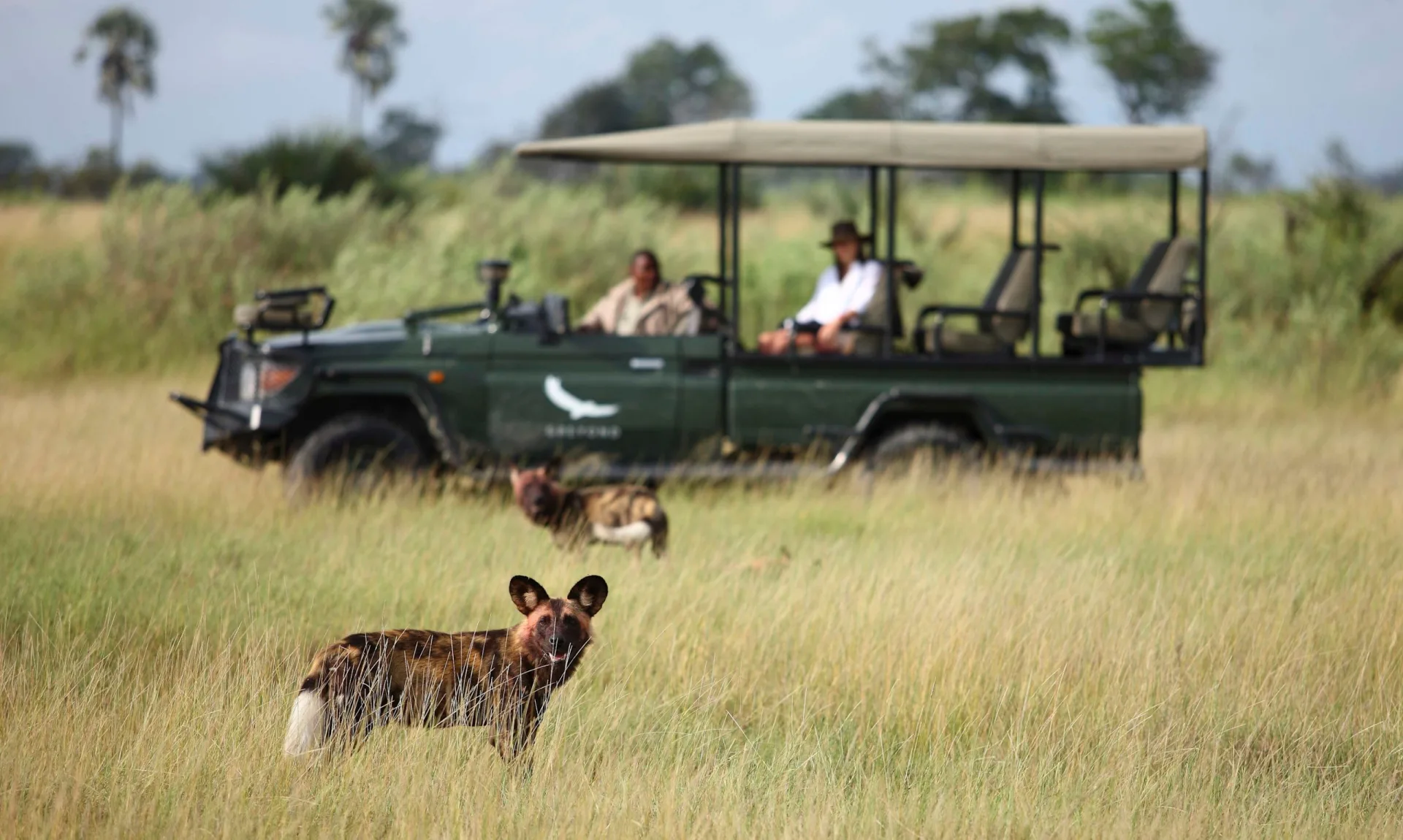
The Okavango is the best place in Africa to see wild dog, the continent's most endangered large carnivore, alongside strong lion and leopard. The Serengeti has one of the highest big-cat densities anywhere, with lion, cheetah on the open plains and leopard along the rivers. Both are first-rate predator destinations, but they showcase different species.
The Serengeti is the better value. Its range of camps runs from comfortable to ultra-luxury, and it can be reached by road as well as by air. The Okavango is almost entirely fly-in, with small camps on private concessions, typically USD 1,000 to over USD 3,000 per person per night. You pay for the water, the space and the very low visitor numbers.
The Delta's private concessions allow off-road driving, night drives, walking and water activities, so the experience is varied and active. Much of the Serengeti is national park, where vehicles stay on the tracks and there are no night drives, though the bordering conservancies do allow off-road and night drives. For the migration itself, see our Great Migration guide.
Choose the Okavango Delta if you want water-based safari, genuine remoteness, wild dog and a small-camp, exclusive feel, and the cost is not a barrier. Choose the Serengeti if you want the Great Migration, the highest concentrations of big cats and a wider choice of budgets. They combine well too, on a longer trip that pairs the plains of East Africa with the water of Botswana.
The Okavango Delta is a water-based wilderness in Botswana, explored by mokoro and 4x4, known for wild dog. The Serengeti is vast savannah in Tanzania, home to the Great Migration and very high big-cat numbers.
The Serengeti, without question. It hosts the Great Migration of around two million wildebeest and zebra. The Okavango Delta has no migration; it offers dense resident game that concentrates around the floodwaters instead.
The Okavango Delta is the best place in Africa to see wild dog, the most endangered large carnivore on the continent. The Serengeti has wild dog too, but they are far less reliably seen there.
Yes. The Serengeti offers a wide range of camps and can be reached by road, while the Okavango is almost all fly-in, with small camps typically USD 1,000 to over USD 3,000 per person per night.
Not really. The Serengeti is dry savannah, and its activities are land-based game drives. Water safari by mokoro canoe and boat is a defining feature of the Okavango Delta, not the Serengeti.
Lion, leopard, elephant and buffalo, yes, in good numbers in both. Rhino are the gap: they are scarce in the Okavango and very scarce in the Serengeti, so neither is a reliable rhino destination.
The Okavango Delta. Its small fly-in camps on private concessions keep visitor numbers very low. The Serengeti is far larger and busier, especially in the central Seronera area, though it still feels vast.
They make a strong combination on a longer trip, pairing East African plains and the migration with Botswana water and wild dog. They are in different countries, so allow time for the flights between them.
Tell us roughly when you would like to travel and what you most want to see. Every enquiry is answered personally, usually within 24 hours. No set packages, no booking fees.