
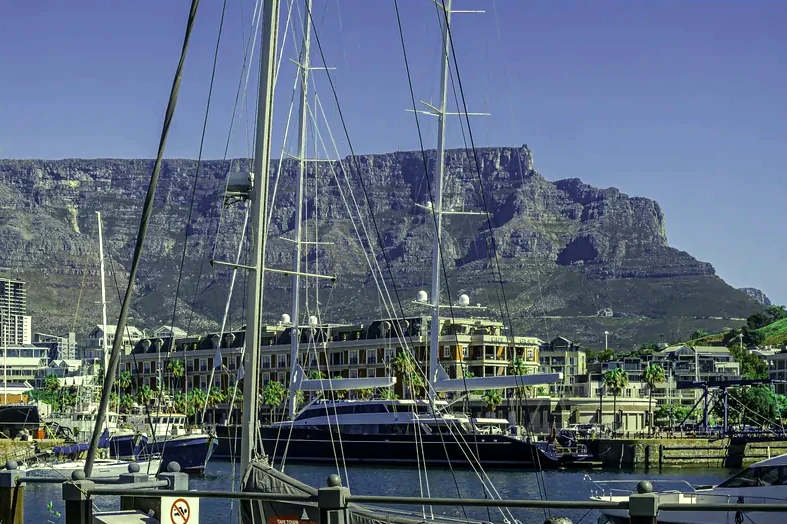
Most first-time visitors to South Africa arrive wanting two very different things: the wildlife and the coast. You don’t have to choose between them. Cape Town and a Big Five safari sit at opposite corners of the same country, joined by a single flight of roughly two hours. Put them together and you cover the full range of what South Africa does well, from a leopard walking a riverbed at dawn to a glass of Cape white looking out over the Atlantic the next afternoon.
The short answer
Give yourself between eight and twelve days. Spend three or four nights on safari and three or four in and around Cape Town, and fly between the two rather than driving. For the strongest game viewing, base the safari leg in the Sabi Sand next to Kruger. If you are travelling with young children or would rather skip anti-malarials, choose a malaria-free reserve in the Eastern Cape, a short hop down the coast from Cape Town.
Why Cape Town and a safari belong on the same trip
The two experiences have almost nothing in common, and that is exactly the point. Safari mornings start before sunrise and run on the rhythm of the animals. Cape Town runs on long lunches, mountain walks and the light coming off Table Bay. One leg is wild and unpredictable; the other is unhurried. Back to back, they read like two separate holidays for the price of one flight.
Logistically it is one of the easiest pairings in Africa. Cape Town International is a major hub with direct connections to every safari gateway in the country, so you are never more than a morning’s travel from bush to city. Both legs are also genuinely first-rate on their own terms. Cape Town is regularly ranked among the best cities in the world to visit, and the private reserves bordering Kruger hold some of the highest leopard densities anywhere on earth.
I spent more than a decade guiding in these reserves, first as a field guide and later as Head Ranger at andBeyond Phinda, so the safari half of this trip is the part I know from the inside. The advice below is how I would sequence it for my own family.
How many days do you need?
Two nights on safari is the practical minimum, because game viewing is a numbers game and each drive is a fresh roll of the dice. Three or four nights is the sweet spot. Cape Town rewards a slower pace, so build in at least three nights there to cover the city, the Cape Peninsula and the winelands without rushing. Here is how the common trip lengths break down.
| Trip length | Safari | Cape Town & around | Best for |
|---|---|---|---|
| 7 days | 3 nights | 3 nights | A focused first trip with no time to spare |
| 10 days | 4 nights | 4–5 nights | The classic pairing, unrushed on both legs |
| 14 days | 4 nights | 4 nights + Garden Route or winelands stay | Adding the coast, whales or a second reserve |
If you can stretch to ten days, do. Seven works, but you will feel the pace, especially with the flying between legs.
Which safari should you pair with Cape Town?
There is no Big Five reserve within a short drive of Cape Town itself. The Cape is fynbos and coastline, not bushveld, and the small game farms within day-trip range of the city give you a taste rather than the real thing. A proper safari is a flight away, and you have three sensible options depending on who you are travelling with.
| Safari region | Getting there from Cape Town | Malaria | Known for |
|---|---|---|---|
| Sabi Sand & Kruger | Direct Airlink flight to Skukuza, Hoedspruit or Nelspruit (about 2 hours) | Low-risk area; prophylaxis usually advised | Leopard, lion and wild dog at close range |
| Eastern Cape reserves | 1h15 flight to Gqeberha, or a road trip along the Garden Route | Malaria-free | Big Five with young children, no tablets |
| Phinda & KwaZulu-Natal | Connect via Durban or Johannesburg | Low-risk to malaria-free zones | Big Five plus a beach add-on on the same coast |
The Sabi Sand and Kruger, for the best game viewing
If your priority is the wildlife, this is the choice. The private reserves of the Sabi Sand share an unfenced boundary with Kruger, so the animals move freely. Each lodge pairs a ranger with a specialist tracker, and off-road traversing with a small number of vehicles means you get genuinely close to leopard, which is the animal most people come to Africa hoping to see. Airlink flies direct from Cape Town to Skukuza inside the park, as well as to Hoedspruit and Nelspruit, so you can be on an afternoon game drive the same day you leave the city. It is a low-risk malaria area, and this is also the region I would send any serious wildlife photographer.
The Eastern Cape, for families and malaria-free travel
Families with young children, and anyone who would rather not take anti-malarials, should look at the malaria-free reserves of the Eastern Cape. Kwandwe, Amakhala and Shamwari all hold the Big Five and sit within an easy flight of Cape Town to Gqeberha, or a scenic drive along the Garden Route if you want to add whale watching at Hermanus on the way. The game viewing is a step behind the Sabi Sand, but the trade-off in peace of mind is worth it for a lot of travellers. Kwandwe in particular runs a serious black rhino programme, which makes it a strong pick if you care about where your money goes. This is the region I most often recommend for a family safari.
Phinda and KwaZulu-Natal, for bush and beach
Phinda, the reserve where I worked as Head Ranger, sits in the north of KwaZulu-Natal and pairs neatly with the Indian Ocean beaches of the Elephant Coast. It takes a connection through Durban or Johannesburg from Cape Town, so it suits longer itineraries, but it rewards the effort with seven distinct habitats and excellent cheetah and rhino viewing. If you want to end a trip with a few days of sea rather than city, this is the route.
Safari first, or Cape Town first?
I almost always suggest doing the safari first and finishing in Cape Town. Safari days are early and full-on, and it helps to hit them while your energy is fresh and your body clock is still adjusting. Cape Town then becomes the wind-down: sleep in, wander, eat well, and let the trip settle before you fly home. Going the other way works too, but few people want a 5am wake-up for a game drive on their last morning in Africa.
The one thing that overrides this is the weather, which brings us to timing.
The best time of year to combine them
Cape Town and the safari reserves peak in opposite seasons, and that is the one genuine tension in this trip. The bush is at its best in the dry winter months from roughly May to September, when the grass is low, water is scarce and animals gather at the remaining rivers. Cape Town is at its best in the dry summer from November to March, when the days are long and warm. Neither window ruins the other, but if you are forced to pick, the shoulder months of April and October give you the fairest compromise across both legs. For a full breakdown of the trade-offs, read our guide on when to go on safari.
A sample 10-day Cape Town and safari itinerary
This is the ten-day trip I would build for a couple or a family visiting for the first time, safari first and Cape Town to finish.
- Days 1–2: Arrive in Johannesburg, connect to the Sabi Sand. Afternoon game drive on the day you land.
- Days 3–4: Full days on safari. Morning and afternoon drives, a bush walk, and time to actually sit still at the lodge between them.
- Day 5: Fly from Skukuza or Nelspruit direct to Cape Town. Settle in, dinner near the waterfront.
- Days 6–7: Cape Town proper. Table Mountain on the clearer of the two mornings, the Cape Peninsula and Cape Point, Boulders Beach penguins.
- Day 8: The winelands. Stellenbosch or Franschhoek for lunch and a slow afternoon of tasting.
- Day 9: A free day. Hermanus for whales in season, Kirstenbosch gardens, or simply the beach.
- Day 10: Fly home from Cape Town.
The mistake I see most often is people trying to bolt a safari onto the end of a busy city trip and giving it a single night. Two nights minimum, three if you can. The bush does not perform to a schedule.
Frequently asked questions
Can you do Cape Town and a safari in one trip?
Yes, and it is one of the most popular ways to see South Africa. Cape Town connects to every major safari gateway by direct or one-stop flights of around two hours, so the two fit comfortably into a single trip of eight to twelve days.
How many days do you need for Cape Town and a safari?
Plan for at least eight days, and ten is ideal. That allows three to four nights on safari and four or five in and around Cape Town, with the flight between the two built in. Seven days is possible but tight.
Is there a safari near Cape Town?
There is no Big Five reserve within a short drive of Cape Town. The nearest genuine option is the malaria-free Eastern Cape, about a 75-minute flight to Gqeberha or a scenic drive along the Garden Route. Small game farms within day-trip range of the city offer a taste but not a full safari.
Do you need malaria tablets for a South African safari?
It depends on the reserve. The Sabi Sand and Kruger are low-risk malaria areas where prophylaxis is usually advised. The Eastern Cape reserves near Cape Town, such as Kwandwe and Shamwari, are malaria-free, which makes them the easier choice for families with young children. Always confirm current advice with a travel clinic.
Should you do the safari or Cape Town first?
Safari first, in most cases. Game drives are early and demanding, so they suit the start of a trip when your energy is high. Finishing in Cape Town gives you a relaxed few days to unwind before flying home.
How do you get from Cape Town to Kruger?
Airlink flies direct from Cape Town to Skukuza inside Kruger, as well as to Hoedspruit and Nelspruit, both gateways to the private reserves. The flight takes about two hours, so you can be on a game drive the same afternoon you leave the city.
Planning your Cape Town and safari trip
The pairing is straightforward on paper, but the details decide whether it flows or feels rushed: which reserve suits your group, how the flights connect, and how to time both legs against the seasons. That is the part I handle personally. If you would like a route built around how you actually travel, get in touch or read more about how luxury safari planning works at Wild Moments.