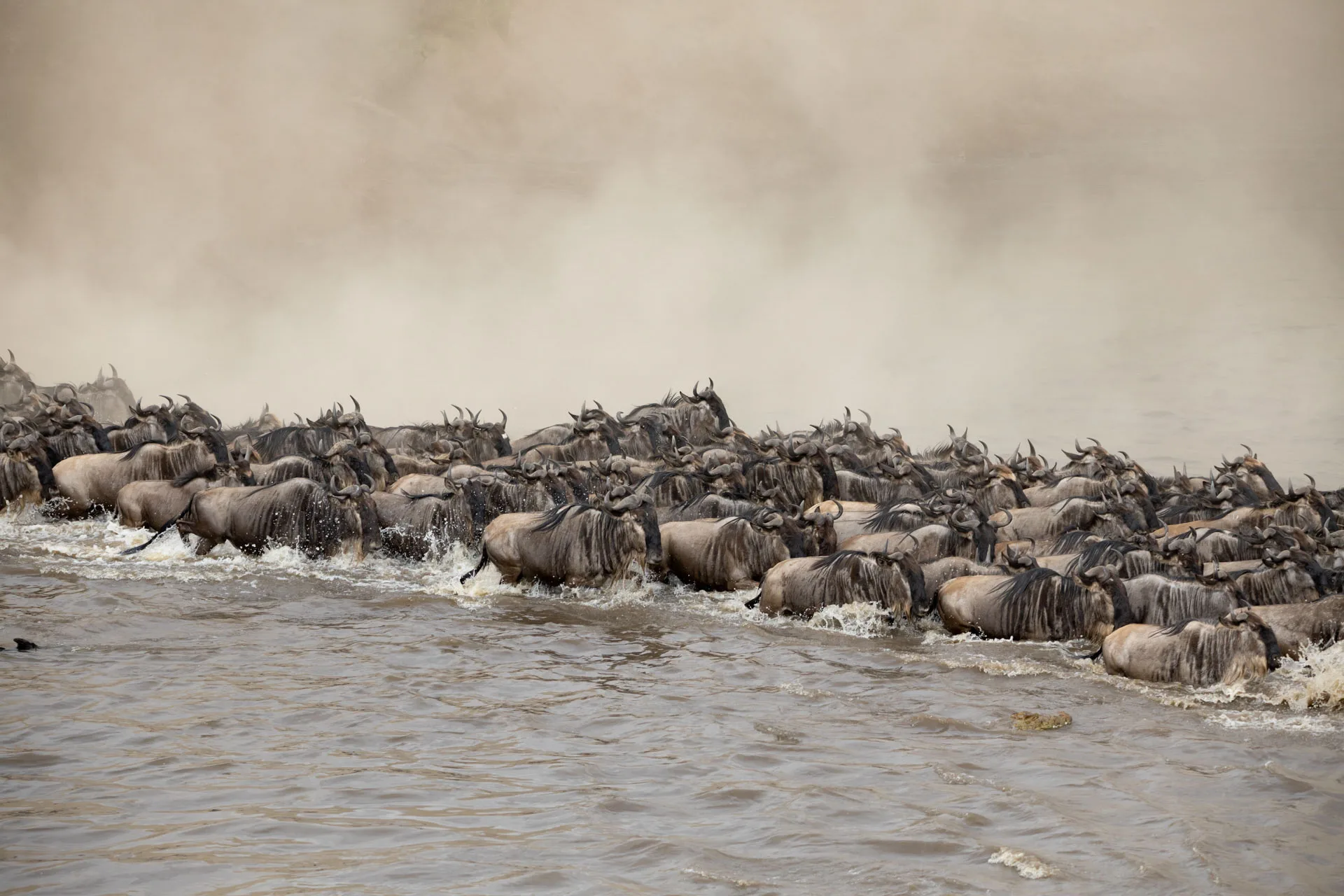
Kenya's flagship reserve, the stage for the Great Migration and some of the best big-cat viewing on earth.
Enquire About Masai MaraThe Masai Mara is the northern tip of the vast Serengeti-Mara ecosystem, and Kenya's most celebrated safari destination. Its rolling grasslands, dotted with lone acacias and crossed by the Mara and Talek rivers, carry one of the highest concentrations of big cats and plains game in Africa, year-round.
From July to October the reserve becomes the climax of the Great Migration. Wildebeest and zebra that have moved north out of the Serengeti gather on the riverbanks before plunging across the crocodile-filled Mara River, in scenes that draw travellers and filmmakers from around the world. Crossings are unpredictable, but when they happen there is nothing like them.
It is important to understand the difference between the national reserve and the surrounding conservancies. The reserve itself holds the river crossings but can be crowded at a sighting, with many vehicles and no off-road driving. The private conservancies that ring it, such as Mara North, Olare Motorogi and Naboisho, cap vehicle numbers and allow off-road and night drives and walking.
The land and its wildlife are inseparable from the Maasai, whose conservancies now protect a huge buffer around the reserve. Staying on a conservancy supports that model directly and gives a quieter, more flexible safari. Our Great Migration guide covers the timing in detail.
The Mara is big-cat country above all. Lion prides are large and well known, cheetah hunt the open plains by day, and leopard haunt the riverine forest. It is one of the few places where all three are seen regularly on a short stay.
During the Migration, the plains fill with wildebeest, zebra and gazelle, and the river crossings concentrate predators and crocodiles. Outside the Migration, resident herds of elephant, buffalo, giraffe, topi and other plains game keep the viewing strong year-round.
Black rhino survive in parts of the ecosystem, spotted hyaena are abundant, and the birdlife is rich, with raptors, bustards and, on the Mara River, hippo pods and Nile crocodiles. The conservancies add the chance of nocturnal species on night drives.
July to October is the prime window, when the Migration is in the Mara and the river crossings are most likely. This is peak season, so the best camps book out a year ahead and the reserve is at its busiest.
The rest of the year is quieter and rewarding in its own right, with excellent resident game and far fewer vehicles. The long rains of April and May are the low season, green and cheap, though some camps close.
Iconic camps with sweeping Mara views and superb guiding, at the very top of the market and ideally placed for the Migration.
Established luxury camps on the reserve's western edge, combining classic game viewing with comfort and strong service.
Camps in the private conservancies offer off-road and night drives, walking and far fewer vehicles, while supporting Maasai landowners directly.
Long-running camps in good locations that deliver the Mara experience at a more accessible price.
Light mobile camps follow the season and offer a more affordable way to be in the Mara for the crossings.
The Mara is one of the finest photographic destinations in Africa: open plains, dramatic skies and big cats in soft light, with the Migration crossings as the headline event. Conservancy camps allow off-road positioning for clean angles that the national reserve does not.
The Mara works at every level, from mobile Migration camps to ultra-luxury lodges. For the quietest, most flexible experience choose a conservancy; for the river crossings themselves, stay in or beside the national reserve.
The Masai Mara is in south-western Kenya, reached by a short light-aircraft flight from Nairobi's Wilson Airport, or a longer road transfer. The flight in over the Rift Valley and the plains is a highlight in itself.
We arrange every detail, from the right camp to flights and transfers. Tell us your dates and we will do the rest.
Plan My Safari WhatsApp UsGenerally between August and October, though the herds are in the Mara from around July. Crossings are unpredictable and depend on the rains, so a stay of several nights improves your chances.
The national reserve has the river crossings but more vehicles; the conservancies offer off-road and night drives and far fewer people. Combining both is the ideal.
The national reserve can be busy at major sightings during peak Migration season. Staying in a private conservancy avoids the crowds while keeping you close to the action.
Three to four nights is ideal, particularly in Migration season, to give the unpredictable river crossings time to happen.
Lion, leopard, elephant and buffalo are readily seen. Rhino survive in parts of the ecosystem but are harder to find, so the full Big Five is not guaranteed.
By a short scheduled or private light-aircraft flight from Nairobi's Wilson Airport to one of the Mara airstrips, or by road for the more adventurous.
Tell us roughly when you would like to travel and what you most want to see. Every enquiry is answered personally, usually within 24 hours. No set packages, no booking fees.