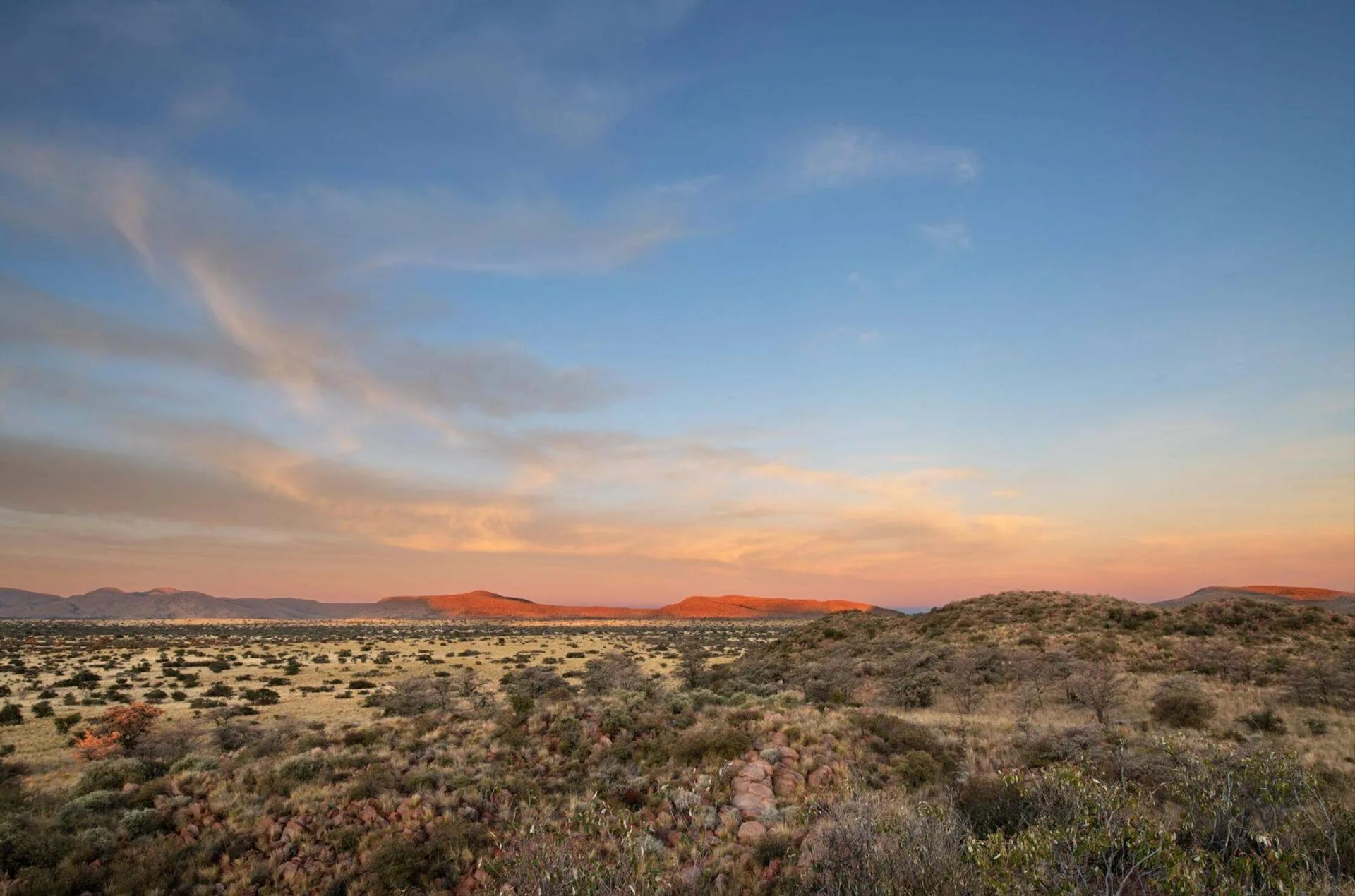
South Africa's largest private reserve, in the southern Kalahari, where a private vehicle is standard and the rare species are the point.
Enquire About Tswalu KalahariTswalu covers 1,200 square kilometres of the southern Kalahari in the Northern Cape, which makes it the largest private game reserve in South Africa by a wide margin. The name means "a new beginning" in Setswana. The reserve was pieced together from former farmland and has been in the hands of the Oppenheimer family since the late 1990s, who have spent close to three decades pulling down fences and putting the land back together.
The scale changes how a safari works here. Red dune fields run up into the Korannaberg mountains, and 85 mammal species are spread thinly across all of it, so sightings are worked for rather than driven to. Every party gets its own vehicle, guide and tracker as standard rather than as a paid upgrade, which means you set the pace and can give an aardvark two hours if that is what the morning offers.
Be clear about what Tswalu is not. There are no elephant, so this is not a Big Five reserve. What it holds instead is Kalahari black-maned lion, cheetah, desert black rhino, African wild dog and Cape buffalo, alongside the animals most safaris never produce: pangolin, aardvark, aardwolf, brown hyaena and bat-eared fox, the group the reserve calls the elusive five.
Research runs alongside the guiding. The Tswalu Foundation funds long-term ecological work out of the Dedeben Research Centre, from pangolin rewilding to sociable weaver colonies, and the reserve became South Africa's first Vulture Safe Zone. Guests can spend time with the researchers, which puts it among the more substantial conservation safaris in the country.
Two lion prides hold the reserve, and the black-maned Kalahari males are the signature sighting. Cheetah do particularly well on the open ground between the dunes, and Tswalu is one of the better places in southern Africa to watch them hunt. Leopard are present in the Korannaberg but stay genuinely difficult to find.
The elusive five are why many guests book. Pangolin, aardvark, aardwolf, brown hyaena and bat-eared fox are all nocturnal, and this is one of the few reserves in Africa where seeing several of them in a week is a reasonable expectation rather than luck. Three habituated meerkat colonies can be visited at their burrows on an early drive.
Antelope are the Kalahari's quiet strength: gemsbok on the dune crests, plus roan, sable, eland, red hartebeest and springbok, and the rare Hartmann's mountain zebra in the Korannaberg foothills. Birding runs to 264 species, with the vast communal nests of sociable weavers and the pygmy falcons that squat in them among the more distinctive sightings.
Winter, May to September, is the strongest all-round window. Cold nights push aardvark and pangolin out to forage in the afternoon sun, so species that need a late-night drive in summer are often seen in daylight. Days are clear and mild, and the thin vegetation makes tracking easier.
Summer, November to April, brings rain, green dunes and newborn antelope, along with the brown-veined white butterfly migration and the best birding of the year. Middays are hot, and a drive after dinner becomes the way to find the nocturnal species.
The main camp: nine legae, or suites, taking a maximum of 18 adults, with a waterhole in front of the guest area that pulls in game through the dry months.
Six standalone safari homes taking two or four guests each, every one with its own chef, guide and vehicle, set on open grassland below the Korannaberg.
A five-suite private homestead for up to ten guests in a secluded valley, taken on a sole-use basis with its own staff and vehicles. The obvious choice for a family or a group travelling together.
Every booking comes with a dedicated vehicle, guide and tracker, built into the rate rather than sold as an extra. It is the single thing that most changes how the reserve feels.
Red sand, low winter light and a private vehicle on every booking make Tswalu one of the best photographic reserves in South Africa. Nobody else in the vehicle is waiting to move on, there is no queue at a sighting, and the guide will position for the light rather than the view. The chance at pangolin, aardvark and brown hyaena takes the subject list well beyond the usual. See our photographic safaris.
Tswalu sits at the top of the market and prices accordingly. It suits returning safari travellers who have done the Big Five and now want the species they have never seen, photographers who need control of the vehicle, and families or groups who can fill Tarkuni or a Loapi home. It is malaria-free, which makes it workable for a family safari. First-timers set on elephant and a full Big Five list are better served in the Sabi Sands.
Tswalu lies in the southern Kalahari in the Northern Cape, at the foot of the Korannaberg mountains near Van Zylsrus. Almost everyone flies in, to the reserve's own airstrip, on a charter from Johannesburg or Cape Town. Driving is possible for anyone already touring the Northern Cape, but this is remote country and the distances are long.
We arrange every detail, from the right camp to flights and transfers. Tell us your dates and we will do the rest.
Plan My Safari WhatsApp UsTswalu covers 1,200 square kilometres of the southern Kalahari, which makes it the largest private game reserve in South Africa. The scale is a large part of the appeal, and the reason game is spread thin and sightings are worked for.
No. There are no elephant at Tswalu, so it is not a Big Five reserve. Lion, leopard, buffalo and desert black rhino are all present. Travellers set on the full Big Five are better served in the Sabi Sands or Greater Kruger.
Pangolin, aardvark, aardwolf, brown hyaena and bat-eared fox. All five are nocturnal and rarely seen elsewhere. Tswalu is one of the few reserves in Africa where a week gives you a realistic chance at several of them.
Yes. Every booking includes a dedicated vehicle, guide and tracker as standard rather than as a paid upgrade, so you set your own pace and can stay at a sighting as long as you want.
Yes. Tswalu is in the Northern Cape, which is malaria-free, so no antimalarials are needed. That makes it workable for families and for anyone who would rather avoid the medication.
May to September. Cold nights bring aardvark and pangolin out to forage in the afternoon sun, so the elusive species are often seen in daylight rather than on a late drive. Summer is greener, hotter and better for birding and butterflies.
Tell us roughly when you would like to travel and what you most want to see. Every enquiry is answered personally, usually within 24 hours. No set packages, no booking fees.