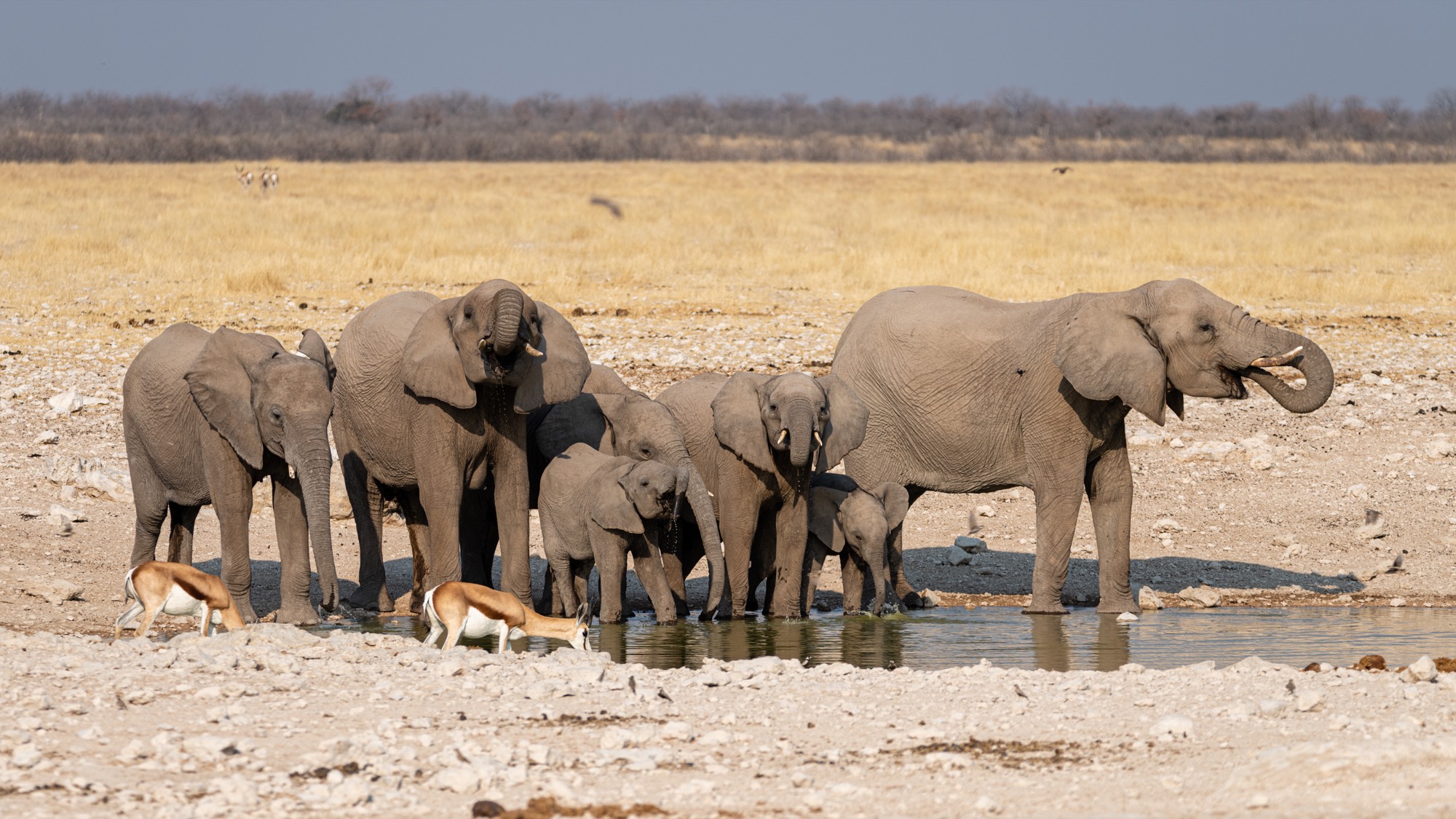
A vast salt pan ringed by floodlit waterholes, the closest thing to classic game viewing Namibia offers.
Enquire About Etosha National ParkEtosha National Park is built around a vast, flat salt pan, visible from space, that floods briefly after rain and otherwise shimmers white and nearly lifeless. Around its edges, a ring of waterholes draws almost everything that lives in the park, which is what makes Etosha Namibia's most reliable game-viewing destination by a wide margin.
The dry season turns this into genuine theatre. Several camps, including the government-run Okaukuejo and Halali, floodlight their waterholes at night, so guests can sit and watch elephant, rhino and lion come to drink without ever boarding a vehicle. It is a different rhythm from a classic game drive, patient and still rather than searching, but it produces some of the most intimate sightings in southern Africa.
Etosha is also one of the continent's stronger black rhino strongholds, a result of decades of protection in a landscape too dry and exposed for poachers to operate easily. Lion, elephant, giraffe, zebra and a wide range of plains game are common; buffalo are present but limited to the wetter eastern section, and leopard, while present, are harder to find than in a private reserve further south.
Elephant, lion, giraffe, zebra, springbok and a wide range of plains game concentrate at waterholes through the dry season, producing some of the most predictable viewing in Namibia.
Black rhino numbers here are among the highest of any single park in Africa, and night-time waterhole sightings at Okaukuejo in particular are a signature Etosha experience.
Leopard and cheetah are present but more elusive than in a private Greater Kruger reserve, and buffalo are confined to the wetter eastern reaches of the park.
May to October, the dry season, is by far the best window. As surface water elsewhere dries up, game is pulled toward the park's permanent waterholes, and September and October are typically the most concentrated, if also the hottest and dustiest.
The wet season, November to April, scatters game across a much larger area as temporary pans fill, and sightings become less predictable, though the park turns green and birding improves markedly.
Private concessions bordering the park's southern boundary, offering off-road game drives and night drives that the public park itself does not allow.
Government-run rest camps with the park's best floodlit waterholes directly on site, the classic budget-to-mid-range Etosha base.
A restored German colonial fort in the east of the park, a comfortable, affordable base near the wetter section where buffalo are found.
Etosha's stark white pan and floodlit waterholes make for high-contrast, dramatic images, particularly animals silhouetted against the pan at dawn or lit against the dark at a night waterhole. The dust of late dry season adds atmosphere but also haze, worth factoring into lens choice.
Etosha suits budget self-drivers at the government camps and luxury travellers on the private concessions equally well, and is the single best Namibia stop for anyone whose priority is game sightings over scenery.
Etosha lies in northern Namibia, roughly a four to five hour drive from Windhoek, or reachable by light aircraft to one of several private airstrips on its margins.
We arrange every detail, from the right camp to flights and transfers. Tell us your dates and we will do the rest.
Plan My Safari WhatsApp UsSeveral camps floodlight their waterholes at night, letting guests watch elephant, rhino and lion drink after dark without a vehicle, a sit-and-wait style of viewing unique to Etosha.
Mostly. Lion, leopard, elephant and rhino are all present, but buffalo are limited to the wetter eastern section, and leopard take more effort to find than in a private reserve.
Yes. Roads within the park are well maintained gravel, suitable for a standard rental vehicle, and the government rest camps make a self-drive loop straightforward.
May to October, the dry season, when game concentrates at the waterholes. September and October are the most concentrated but hottest months.
Tell us roughly when you would like to travel and what you most want to see. Every enquiry is answered personally, usually within 24 hours. No set packages, no booking fees.